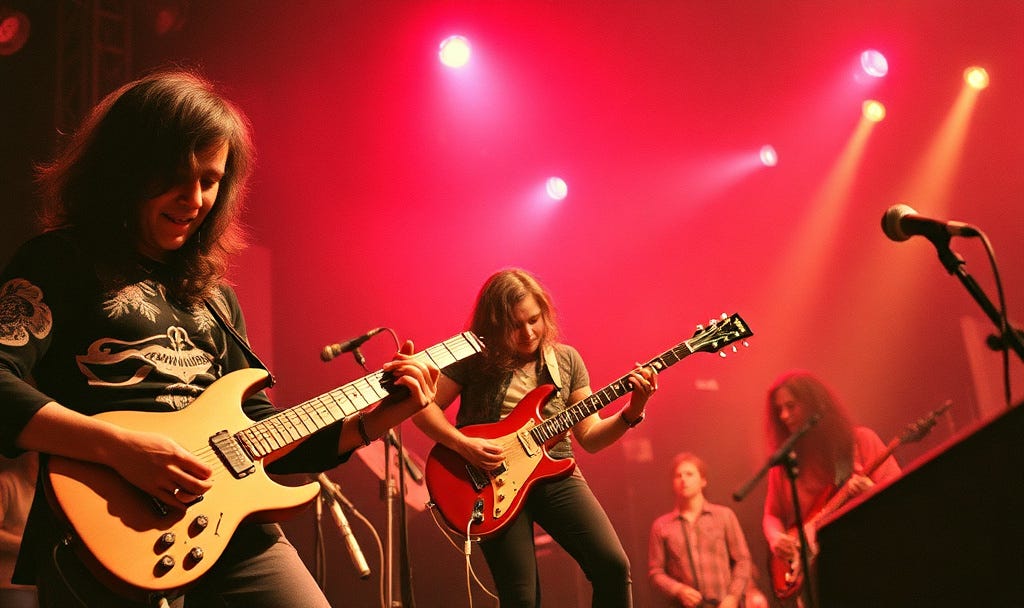
Fuzz, Feedback, and Freedom: Exploring 1960s Underground Psychedelic Rock
This is background for the Music 101 podcast, and the live interview is posted.

Introduction: The Architecture of the Underground
Welcome to Music 101. Today, we are stepping away from the neon lights of the “Summer of Love” and descending into the damp, vibrating basement of the true 1960s underground. We aren’t talking about the polished hits that played on every AM radio station from coast to coast. Instead, we are exploring the canon—the records that served as the literal floorboards of the psychedelic movement. This is a comprehensive, deep-dive expansion designed for the Music 101 podcast and Substack. In this dialogue, we explore the psychedelic canon, bridging the gap between 1950s rock foundations and the 1970s avant-garde. This is the sound of the blues, folk, and garage traditions being systematically dismantled and reordered into something transcendent, paranoid, and profoundly human.
In conclusion, join us as we navigate this sonic labyrinth and understand how these frequency shifts mirror the psychological and spiritual hunger of an era, grounded in the raw power of 1950s–1970s rock.
I. The Instrumental Melt: Fuzz, Surf, and Sonic Ego-Death
When most people think of 1965 and 1966, they think of the British Invasion or the Motown hit factory. But you’ve often argued that another spark of the psychedelic era happened in the margins—specifically with instrumental acts that pushed their gear to the breaking point. Why start with Davie Allan & The Arrows?
To understand the psychedelic movement, you have to look at the transition from the physical to the metaphysical. In the early sixties, surf rock was about the body—the wave, the car, the physical thrill. But by 1967, something shifted. On Side 1 of Cycle-Delic Sounds (1967), Davie Allan & The Arrows took that West Coast instrumental surf template and, quite frankly, doused it in Owsley acid.
They weren’t just playing louder; they were utilizing the “fuzz” pedal not as an effect, but as a primary voice. The opening title track, “Cycle-Delic (From Night on Earth),” is six minutes of mind-blowing, fuzzed-out distortion.
There really wasn’t a group here, and Davie teamed up with session musicians and basically anyone who was around. Davie was the central figure in a series of movies: Skaterdater, The Wild Angels, Devil's Angels, Thunder Alley, and The Born Losers.
While Link Wray was the pioneer of guitar distortion, and Allan's penchant for extreme, heavy, noisy guitar work presaged 1980s acts like Sonic Youth..
In conclusion, the instrumental fuzz of Davie Allan provided the jagged, electrified foundation upon which the more lyrical structures of the era would eventually be built.
II. The Raga-Pop Bridge: San Francisco’s High Liturgy
Moving from the garage to the ballroom, we have to talk about the San Francisco Sound. You’ve suggested that if we want the “fabled” version of that sound, we shouldn’t look at the big hits first, but at a live recording from 1966: The Great Society’s Conspicuous Only In Its Absence. Why does this specific side crush the more famous versions we know?
This is unvarnished. This is Grace Slick’s first band, recorded live at The Matrix. Side 1 is a masterclass in the live liturgy. When you listen to their cover of The Jaynettes’ 1963 hit “Sally Go ‘Round The Roses,” you hear an early raga-inspired cover that predates the polished folk-rock boom.
The Jaynettes took the song on Music Vendor to #1, Billboard #2, Cash Box #3, and R&B Chart #4.
The Great Society - “Sally Go ‘Round The Roses” version failed to chart.
The psychedelic sound was so new that it had not hit the mainstream yet. It was their first album released and consists of recordings made during a live concert performance by the band at The Matrix club in San Francisco in 1966. The Great Society version was released on Conspicuous Only in Its Absence, released in 1968 by Columbia Records.
Then you have the original version of “Somebody To Love” by The Great Society.
The Jefferson Airplane version is a towering pop achievement.
Although The Great Society’s version—followed by tracks like the Grace Slick penned “Didn’t Think So“ and “Grimly Forming“—crushed the Airplane cover like a cockroach.
Written by Grace Slick.
“Never Thought That it could be,
The One Face That I'd Love,
Never Thought That I could place,
That One Above The other,
But His way of turning On seemed right to me,
and I think that he'll make me free.
Things that he chooses to,
put in his mind,
Seem To To Have Placed His Sadness,
Behind him,
And If I have To Follow,
It will change the way he lives,
And with me his Sovereignty,
Can't be Lost By what I give,
And If he mentions leaving
I can't do no more,
To make Him stay Behind an open door,
The love That he looses
He will find again another way,
And I won't be The One to Tell Him,
Where He Must Play.
When I first Met Him,
He was Glaring At Me,
And I Think It was Black That He,
was Wearing At The Time,
But He Spoke Of Changes,
And Said Come With Me,
And I was Glad To Leave,
I have heard So many Things,
I never Thought I'd feel Before,
And I won't be Through with him,
Until He sits like a raven”
The Great Society is more desperate, more frantic—it’s the sound of the uninitiated heart searching for a home. It’s grounded in a psychological depth that doesn’t care about the charts. Even Side 2’s original “White Rabbit“ feels more like a dark, Spanish-influenced incantation than a radio single.
“One pill makes you larger
And one pill makes you small
And the ones that mother gives you
Don't do anything at all
Go ask Alice
When she's ten feet tall
And if you go chasing rabbits
And you know you're going to fall
Tell 'em a hookah smoking caterpillar
Has given you the call
Call Alice
When she was just small
When men on the chessboard
Get up and tell you where to go
And you've just had some kind of mushroom
And your mind is moving slow
Go ask Alice
I think she'll know
When logic and proportion
Have fallen sloppy dead
And the White Knight is talking backwards
And the Red Queen's "off with her head!"
Remember what the dormouse said;
"FEED YOUR HEAD’"
This too was written by Slick and was Jefferson Airplane's second album, but the first album by the band with vocalist Grace Slick and drummer Spencer Dryden.
The Jefferson Airplane version went mainstream and was certified gold by the RIAA. The song appeared on Surrealistic Pillow and peaked at #3 on the Billboard album chart.
Part of the innovation was the raga-inspired sound. It started a trend, and there was a genuine attempt to integrate Eastern concepts of time into Western pop.
The earlier version makes the story interesting because it was released in 1968 to cash in on Slick’s fame. Still, it actually serves as a more authentic document of the psychedelic 1966 formation.
These musicians were reading the Upanishads and listening to Ravi Shankar, trying to find a transcendent frequency that the three-minute pop song couldn’t contain. The Beatles in England were looking around for more exotic inspirations as well.
For many western listeners on American radio, it was the first time they heard Indian classical music, or at least something resembling it. One of the many flavours that make up the sound of The Beatles is their free and open use of Indian instrumentation, practices, and techniques. A full-on tribute appears on “Within You Without You.”
Along with the other West Coast bands, The West Coast Pop Art Experimental Band needs a mention, in particular, Side 1 of Part One (1967).
This side is a masterclass in early psychedelia. The band was led by an eccentric millionaire (Bob Markley) who recruited genuine musicians to create a strange, fragile, and often paranoid version of the L.A. sound. Tracks like “Transparent Day” and “I Won’t Hurt You” (which was recently rediscovered by a new generation) feature a “whisper-thin” vocal delivery that feels like a man telling the truth while being watched. It is psychedelia as a fragile, internal state rather than a loud, external explosion.
The band would not be too far from sounding like the Moody Blues, who would explore a similar sonic territory. The difference, of course, is that you would never mistake this as a British band; these guys were all from San Francisco.
Featuring David Lindley, Kaleidoscope was arguably the most musically diverse of the era. Lindley was known for founding the rock band El Rayo-X and worked with many other performers, including Jackson Browne, Linda Ronstadt, Ry Cooder, Bonnie Raitt, Warren Zevon, Curtis Mayfield, and Dolly Parton. He mastered such a wide variety of instruments that Acoustic Guitar magazine referred to him not as a multi-instrumentalist but instead as a "maxi-instrumentalist."
A Beacon from Mars (1968) blended Middle Eastern, Appalachian, and Cajun influences into a psychedelic stew.
The title track on Side 2 is the famous one, but Side 1’s “Life Will Pass You By” is a masterclass in using different cultures to sharpen one’s own musical thinking.
Not all the bands from the area fit neatly into a San Francisco sound. Mad River, on their LP Mad River (1968), was a Berkeley band that leaned into the era with jagged, dissonant guitars.
“The War Goes On” is a 12-minute epic that avoids all the clichés of the San Francisco sound.
“THE WAR GOES ON”
by Lawrence Hammond
”She’s been riding there for days
In an iron truck, her head tied to her knees
She’s fifteen, wears wire mesh stockings
At times she can hear the driver breathe
And he turns his head
And he speaks across his shoulder
"My wife wanted heroes
And so then I told her
I lay there and waited for one with my number
But somehow I lived to be much older."
Tonight I’m waiting for it to fall
A drop of water, the first I’ve had today
If I can just get my mouth beneath it
When it falls my tongue will go away
And the engine shakes
And the drop hits my shoulder
And the sun comes out
And I wish that it were colder
I used to live where winter followed summer
But somehow I lived to be much older
(It’s getting hotter)
I remember when…
(My head is bouncing)
My tongue froze to the gate
They called the doctor
(The dust creeps in again)
In Wisconsin, they pried my tongue away
That’s when I found her lying by the road
The trucks rolled by
The dust soaked my clothes
She called for water from the spring
She called me "driver," she could not see a thing
When I got back, the birds…
Flew 'round something by the side of the road…
Picked the veins from her hands like they were worms
I muttered to myself, “You poor little broad"
Poor broad!
Stood her body up in a field of flowers
Don’t ask me why… to scare away the crows, I guess…
The crows I guess…
The crows I guess…
I guess…
I guess…”
It is dark, complex, and requires the listener to “Submit to the Process” of the music. It is the perfect closing side for a man who has stopped drifting and started standing his ground.
In conclusion, the West Coast recordings capture the precise moment when the folk tradition was dismantled and reassembled into a high-octane, raga-infused ritual.
III. Texas Poetry in Motion: The Mysticism of the 13th Floor Elevators
We can’t talk about the psychedelic canon without heading to Texas. Most people point to the 13th Floor Elevators’ debut, but let’s consider Side 1 of their second album, Easter Everywhere (1967). Why is this the “poetry in motion” of the era?
Because Roky Erickson and Tommy Hall weren’t just making garage rock, they were writing a new scripture. Easter Everywhere is where the Texas freak-out meets a deep yearning for the light. Side 1 opens with the epic “Slip Inside This House.”
The lyrics are essentially a manual for internal reordering. When Roky sings, “Draw from the well of spirit / Never fear to make it known,” he’s echoing the engagement of the Transcendent principle we see in mystical literature like The Shepherd of Hermas. It’s the metaphysical circus applied to the soul.
Side 1 also includes “Slide Machine,” “She Lives,” and a superb cover of Dylan’s “It’s All Over Now, Baby Blue.”
Here, Dylan’s lyrics aren’t just about a breakup; they are about the shattering of the old world to make room for the new.
Roky was not done, and he was also involved with The Red Krayola, The Parable of Arable Land (1967).
This is the sound of Texas Freak-out taken to its logical, chaotic conclusion. The recording features “Free-Form Freak-Outs” between the structured tracks.
It wasn’t meant for the charts; it was meant to provide a frame for a listener’s own internal reordering.
If you could listen to early Pink Floyd, the band was exploring similar sonic sounds, and for that time, if you had headphones and were quiet, you would travel to another dimension of your mind.
In conclusion, these recordings represent the peak of psychedelic lyricism, where the grit of the Texas landscape meets the soaring aspirations of the mystical mind.
IV. Urban Truth-Telling: The Fugs and the New York Underground
Let’s head to the Eastern seaboard, first to New York City. A band to mention is The Fugs as the first and best underground rock outfit. Their 1966 self-titled second album is a far cry from the “peace and love” vibes of California. What were they trying to accomplish?
The Fugs were the internal resistance of the New York scene. Led by poets Ed Sanders and Tuli Kupferberg, they were the brutally simple voice of the Greenwich Village underground. While the West Coast was looking at the sun, The Fugs were looking at the shadow. Side 2 features the 11-minute epic freak-out “Virgin Forest.”
This wasn’t meant to be pretty. It was music created to offend the squares. Tracks like “Kill For Peace“ and “Morning, Morning“ were direct, visceral reactions to the psychological trauma of the era—a truth-telling that bypassed the metaphors of the hippie movement.
Let’s face it, how timely the band was by recording, to kill for peace, which sounds current and could fit in easily to today’s conflicts.
Another Eastern initiative was the Bosstown Sound (or Boston Sound) which was the catchphrase of a marketing campaign to promote psychedelic rock and psychedelic pop bands in Boston, Massachusetts, in the late 1960s. The concept was conceived by the record producer Alan Lorber as a marketing strategy intended to establish several underground musical artists native to the city on the national charts and compete with the popular San Francisco Sound. Lorber chose Boston for his plan because of the several bands developing in the city, the abundance of music venues (such as the Boston Tea Party), and the proximity of MGM Records, which had signed the core groups.
Preeminent of these groups is Ultimate Spinach, for example, Side 1 of Ultimate Spinach (1968).
The “Bosstown Sound” was often dismissed by critics as a marketing ploy, but Side 1 of this debut is a masterpiece of multi-layered, baroque psychedelia. “(Ballad Of) The Hip Death Goddess” utilized complex vocal harmonies and fuzz-organ textures to create a sense of a meticulously constructed dreamscape.
In conclusion, Eastern bands provided the urban, cynical, yet deeply human counterpoint to the more polished sounds of the psychedelic mainstream.
V. The Avant-Garde Blues: Captain Beefheart’s “Tarotplane”
What would you say is one of the most challenging entries during this period?
One of the most challenging entries is Captain Beefheart & His Magic Band. Specifically, the Mirror Man sessions from 1967 (released in 1971).
Side 1 is a long psychedelic groove, and Don Van Vliet bridges the gap between 1930s country blues and the space-age future. The blues is a psychedelic iturgy and dominated by the 19-minute epic “Tarotplane.”
Captain Beefheart takes Robert Johnson’s 1936 country blues “Terraplane Blues“ and dismantles it.
He isn’t just covering a song; he’s performing an exorcism of the structure. It’s as far ahead of its time as it is behind it. In the history of religions, this is syncretism—the blending of different beliefs. Beefheart blends the delta blues with a neuroscience of rhythm. The 8-minute “Kandy Korn“ is another mind-blowing performance, utilizing proximity and repetitive guitar weaves to create a sacred space of pure, vibrating energy.
The critics noted the length of its four compositions more than anything else. At the time, other bands were experimenting with long blues compositions, such as the nineteen-minute "Revelation" from Love's Da Capo (1966), or the eleven-minute "Alligator" from the Grateful Dead's Anthem of the Sun (1968).
In the mainstream, even Cream extended their “Spoonful” for 16 minutes; the fans’ attention spans shouldn't have any trouble with Captain Beefheart, which is not only better blues jamming but also has more variety.
The Captain Beefheart LP reached a peak UK chart position of #49, although, like all other Magic Band releases, it failed to break into the top 100 in the United States. The Captain capitalized on his Dr. John-sounding voice and then extended the blues into jam-like compositions. Their musical contribution lies in being a psychedelic blues band, which was a stereophonic exploration diverging from the standard blues rock of bands such as Cream.
As mentioned, Love inhabited a similar sonic ground. In particular, side 2 of Da Capo (1966).
While Side 1 had the hits, Side 2 contained one of their signature tracks, “Singing Cowboy.”
And, with “Revelation,” it was one of the first times a rock band dedicated an entire album side to one song, and they played with combining blues with baroque.
The length of the song forces the listener to move past the three-minute dopamine hit into a sustained, often difficult, musical space. Love was doing things in-depth that the Doors began to present to the masses.
In conclusion, Mirror Man proves that the deepest psychedelia wasn’t found in new sounds alone, but in the radical reordering of the oldest blues traditions.
VI. The Electronic Circus: The United States of America and Silver Apples
Let’s talk about 1968. While others were using guitars, Joseph Byrd and Dorothy Moskowitz were using ring modulators and primitive synthesizers on Side 1 of The United States of America. This might be the electronic trauma side.
The opening track, “The American Metaphysical Circus,” is a literal sonic representation of the shattering of the American dream.
It uses a collage of calliope music and electronic hiss to create a state of psychological displacement. It’s the most academic yet visceral psychedelic side ever recorded in Los Angeles. Byrd was a student of John Cage, and you can hear that internal resistance” to the pop machine. They were engaging the transcendent through the machine itself.
And then we have the Silver Apples in NYC. Before the 1970s “Krautrock” movement, Simeon Coxe III was playing a homemade synthesizer he called “The Simeon.”
Side 1 of Silver Apples (1968) is the ultimate build, don’t just consume record. Simeon played his machine while Danny Taylor played tribal, repetitive drums.
Tracks like “Oscillations“ and “Lovefingers“ are pulses of pure electronic energy that bypass the blues-rock structure entirely.
“Oscillations” would not be out of place on an early Pink Floyd LP. It’s neuroscience set to a beat. They literally built their own instruments because the industry didn’t provide the sounds they heard in their heads.
Like the Silver Apples, Fifty Foot Hose built their own electronic instruments. Side 1 of Cauldron (1967) is a terrifying and beautiful blend of avant-garde noise and surprisingly melodic jazz-pop.
It’s interesting how bands used electronics to create a sense of displacement rather than just trippy sounds.
The bands extended not only to America but stretched across the pond as well. The Soft Machine: Side 1 of The Soft Machine (1968) is instructive.
The Canterbury scene’s contribution meant moving away from the blues-rock structure. Side 1 is a continuous suite of jazz-inflected, organ-heavy psychedelia. It represents a new ethos by integrating Kevin Ayers’ whimsical pop with Robert Wyatt’s complex, polyrhythmic drumming.
Also from Great Britain came The Deviants Ptooff! (1967).
The proto-punk psychedelic outfit was led by Mick Farren, an English rock musician, singer, journalist, and author associated with counterculture and the UK underground, who had a significant influence on the development of British proto-punk garage rock music.
This is psychedelia stripped of its flower power pretensions. It is loud, ugly, and brutally honest. It represents the brutally simple act of naming the chaos rather than pretending things are fine.
Another band, from Vancouver, combined a British sensibility with North American grounding. This was The Collectors, a highlight is Side 2 of The Collectors (1968).
This band utilized woodwinds and Gregorian-style chants. The transcendent was their goal in the 19-minute “What Love (Suite)” on Side 2.
It moves from operatic vocals to jazz flute and back again, mirroring the search for a home beyond the secular world.
They also recorded a live 26-minute version on the 'Where It's At' television program on CBC during Christmas in 1968.
In conclusion, the electronic innovation of these bands provided a new, tribal language that bypassed traditional structures to reach a raw, digital truth.
VII. The Gothic Shadow: H.P. Lovecraft and July
As we move toward the end of the sixties, the sun of the Summer of Love begins to set. Let’s point to the Chicago band H.P. Lovecraft, specifically Side 2 of H.P. Lovecraft II (1968), as the shadow version of the San Francisco sound.
If the San Francisco sound was about the sun, this Chicago band was about the shadow. They took the folk-rock harmony of the era and plunged it into a haunting, gothic atmosphere. The side concludes with “It’s About Time.”
It’s a sprawling, jazz-inflected epic that utilizes dual vocals to create a sense of embodied community reaching for something beyond the veil. It captures the eerie, late-night anxiety of 1968—the feeling that the hope was turning into something darker. The song is blues, in a sense, but psychedelic bluesy. Not to be undone, they throw in orchestral elements in the midst of the song.
And across the pond, we have the British cult classic, July (1968).
Side 1 of July is the perfect Post-Sgt. Pepper boom document.
Tracks like “My Clown“ and “Dandelion Seeds“ use heavy phasing and sitar textures to create a high-definition version of heart.
In conclusion, these Gothic and Post-Pepper sides represent the psychedelic era’s transition from technicolor dreams to a more complex, multi-layered reality.
VIII. The Live Liturgy: Quicksilver and the Desert Jam
We end our journey back in San Francisco, but away from the ballroom and into the desert. We’ve highlighted Side 2 of Quicksilver Messenger Service’s Happy Trails (1969), specifically the track “Calvary.” Why is this the “ultimate document” of the era?
Because it is 13 minutes of purely improvised, wordless psych-rock that sounds like a spaghetti western melting in a desert heatwave. It is the people’s band at its most experimental. It proves that you don’t need a hit single when you have a communal groove that can sustain a room for a quarter of an hour. It is the bridge between the 60s garage and the 70s jam culture. It is the live liturgy in its purest form—a ritual of sound that bypasses the need for lyrics to engage the transcendent. It reflects the sacred silence of the desert, where the heart finally finds its home. It’s a literal shattering of the song form.
It’s what Jonathan Z. Smith would call a map of the sonic experience. They weren’t just playing; they were submitting to the process. This is the sound of the era closing, moving from the urban truth-telling of the Fugs to the transcendent silence of the desert jam.
By adding these sides, we have a point-by-point roadmap of the era that covers every geographic and psychological corner: from the electronic innovation of the Silver Apples to the Texas mysticism of the Elevators, and finally to the desert jam of Quicksilver. It’s a complete initiation.
In terms of the psychedelic canon, this is where the music is the space where we finally find our ground.
We’ve had a deep dive into the architecture of the psychedelic underground. This is a masterclass in how music reflects our deepest psychological and spiritual needs. When we consider the time, it was a journey worth taking. In the history of music, the breakthroughs are always found in the margins.
THE GREAT REORDERING
We’ve covered the fuzzed-out surf of California, the raga-rock of the San Francisco ballrooms, the Texas mysticism of the Elevators, the gritty protest of the New York underground, and the avant-garde blues of Captain Beefheart. The picture is becoming clear: the psychedelic era wasn’t just a style; it was a systematic reordering of the human experience through sound.
We’ve seen how these artists used electronic trauma and urban truth-telling to dismantle the traditions of the past. As we moved into the second half of our journey, we looked at the electronic circus, the Gothic Introspection, and the Live Liturgy of the late sixties. We moved from the Garage into the Avant-Garde.
We have to remember that this music was happening against a backdrop of immense trauma—the Vietnam War, the assassinations, and social upheaval. The agency of these musicians was to create a home for the restless soul.
In conclusion, these songs remain the gold standard for the era, proving that the most profound psychedelic experiences were those that bypassed the ordinary world entirely to find a transcendent home in the noise.
The Literary CPR Playbook isn’t a newsletter.
It’s where I unpack how serious thinkers turn ideas into authoritative assets.
American Patriot
G. Mick (The Doctor of Digital) Smith, PhD
https://www.linkedin.com/in/g-mick-smith-phd-24495127/
Subscribe to my LI Newsletter https://www.linkedin.com/newsletters/the-literary-cpr-playbook-7343709688632381440
Book Coach for CEOs, leaders, and visionaries | Authors Get Published | Books that Convert Clients [ Trusted Advisor | Manuscript Doctor 🚨 | Transforming Drafts into Authority Assets | Strategic Publishing Guidance
#PsychedelicRock #60sMusic #VinylCommunity #ClassicRock
#PsychRock #UndergroundMusic #GarageRock #AcidRock #SummerOfLove
#AlbumReview #MusicDiscovery #Psychedelia