
When Intelligence Becomes Cheap: Why Human Authority Will Define the Next Era of Publishing
The Doctor of Digital™ G. Mick Smith, PhD

Pope Leo XIV’s recent social encyclical, Magnifica Humanitas, may prove to be one of the most important intellectual interventions of the early AI age.
Not because it offers technical prescriptions for machine governance.
Not because it attempts to compete with Silicon Valley’s fluency in computational theory.
And certainly not because it offers another reflexive warning about technological change.
Its importance lies elsewhere.
It reframes the entire conversation.
At the center of the encyclical is a profound civilizational contrast: humanity stands between two architectural possibilities.
The first is Babel.
The second is Nehemiah.
Babel represents the perennial temptation of centralized mastery — the belief that enough coordination, enough scale, enough technical sophistication, and enough systematized intelligence can finally overcome the limits of human contingency.
Nehemiah represents something altogether different: rebuilding through covenant, shared responsibility, disciplined discernment, and a recognition that durable human order cannot be engineered into existence from above.
This is not merely a theological distinction.
It is the defining strategic question for publishing, authorship, leadership communication, and intellectual life in the age of artificial intelligence.
We are living through a transition unlike any previous information revolution.
The printing press democratized distribution.
Broadcast media democratized reach.
The internet democratized access.
Artificial intelligence is doing something more radical.
It is democratizing production itself.
For the first time in modern history, the ability to generate competent prose at scale is no longer scarce.
And whenever something once scarce becomes abundant, its market value changes.
This is the economic reality every writer, publisher, executive, and thought leader must now confront.
Raw intelligence is becoming cheap.
The future belongs to what remains rare.
The Commoditization of Intelligence
One of the most striking claims in Magnifica Humanitas is its recognition that technological progress is rapidly transforming intelligence into a commodity.
This insight deserves careful attention.
For centuries, societies organized prestige, authority, and institutional hierarchy around demonstrated intellectual scarcity.
To possess specialized knowledge was to hold social capital.
To synthesize information effectively was to possess leverage.
To communicate complex ideas with precision was to command influence.
These capacities created natural asymmetries.
They separated scholar from novice, strategist from operator, expert from amateur.
Artificial intelligence alters this arrangement.
Machines now perform many of the functions historically associated with intellectual distinction.
They summarize.
They synthesize.
They draft.
They analyze patterns.
They produce plausible interpretations.
They often do so at extraordinary speed.
This does not mean machines possess wisdom.
It means they can increasingly simulate many external signs of intelligence.
And this changes everything.
As economist Thomas Sowell has long argued, economic value is always contextual. Scarcity, not intrinsic quality alone, determines market significance.
Water is indispensable, yet often inexpensive.
Diamonds have comparatively limited practical utility, yet command high value because of relative scarcity.
The same principle now applies to intellectual work.
When coherent text becomes infinitely producible, coherence alone loses distinction.
When every executive can generate a polished article in minutes, polish ceases to differentiate.
When every consultant can produce a strategic white paper through machine augmentation, formal sophistication becomes commonplace.
This is the paradox of AI abundance.
As intelligence outputs become cheaper, actual wisdom becomes more valuable.
The distinction recalls T. S. Eliot’s haunting question:
“Where is the wisdom we have lost in knowledge? Where is the knowledge we have lost in information?”
Today we might update it further:
Where is the discernment we are losing in generation?
The challenge is not that machines will replace human thought.
The challenge is that synthetic fluency will make superficial thought harder to detect.
This creates a dangerous illusion.
It allows institutions to mistake informational throughput for insight.
It encourages leaders to confuse accelerated production with strategic clarity.
It tempts publishers to reward volume over depth.
Like the builders of Babel, we become captivated by scale itself.
But scale without wisdom eventually collapses under its own conceptual incoherence.
The great irony is that as machine intelligence expands, human limitations become newly valuable.
Embodiment.
Experience.
Moral intuition.
Contextual judgment.
The hard-earned ability to distinguish what matters from what merely appears relevant.
These cannot be automated because they are not reducible to computation.
They emerge through lived encounter with reality.
As the biblical writer reminds us, “The fear of the Lord is the beginning of wisdom.”
Wisdom begins not in mastery but in rightly ordered humility.
That may be the first lesson leaders must recover.
Why Authorship Becomes More Valuable as Content Becomes Cheaper
At first glance, the rise of generative systems appears to threaten authorship.
If machines can generate books, essays, commentary, analysis, and marketing copy at scale, does authorship lose its significance?
The opposite is true.
Authentic authorship becomes more valuable precisely because synthetic content becomes cheap.
History offers a useful analogy.
When photography became widespread, painting did not disappear.
It evolved.
Freed from the obligation to merely replicate visual reality, painting became more interpretive, expressive, and conceptually ambitious.
The emergence of photography forced painters to rediscover what only painting could uniquely do.
Artificial intelligence is doing something similar for writing.
It is forcing us to rediscover what only human authorship can uniquely offer.
A machine can generate competent sentences.
It cannot wrestle.
It cannot suffer.
It cannot repent.
It cannot stand in the long, difficult tension between experience and meaning.
It cannot undergo what Augustine described as the restless journey of the heart seeking order.
It cannot inhabit the struggle Solzhenitsyn understood when he observed that the line between good and evil runs through every human heart.
It cannot carry the existential burden Nietzsche identified when he warned that those who fight monsters must take care not to become monsters themselves.
Machines can recombine.
Authors must reckon.
And reckoning is where authority is born.
This is why books will matter more, not less, in the coming decade.
Not all books.
Not formulaic books.
Not hastily assembled books built around market trends.
Those will proliferate, and their abundance will render them forgettable.
The books that will endure are those that perform a rarer function.
They interpret reality.
They restore conceptual order.
They help readers perceive what was previously obscured.
This is what the best books have always done.
Consider Viktor Frankl.
He did not merely provide information about concentration camps.
He interpreted suffering through a framework of meaning.
Consider C. S. Lewis.
He did not simply describe modern moral confusion.
He illuminated its deeper structure.
Consider Hannah Arendt.
She did not merely report on totalitarianism.
She rendered its logic visible.
That is authorship at its highest level.
It names reality with sufficient precision that readers can see differently.
In a world saturated with generated language, this kind of work becomes exponentially more valuable.
The future of publishing therefore depends less on production efficiency than on interpretive seriousness.
Publishers who understand this will thrive.
They will become curators of intellectual distinctiveness.
They will seek authors capable of depth rather than mere fluency.
They will privilege synthesis over scale.
This is where serious thought leadership must move.
The question is no longer whether one can produce content.
The question is whether one has earned the right to say something consequential.
As Ian Hunter once wrote, “Once Bitten, Twice Shy.”
Our culture has been bitten by abundance without discernment often enough.
Readers are becoming more selective.
Trust is becoming more precious.
Authority is becoming more exacting.
That is good news for serious authors.
How Leaders Build Irreplaceable Intellectual Authority in the AI Age
If intelligence is becoming commoditized and authorship is becoming more valuable, how should leaders respond?
How does one build intellectual authority that cannot be replicated by machine output?
The answer begins with abandoning the metrics-driven assumptions that dominate digital communication.
For years, leaders were taught to optimize for visibility.
Post consistently.
Publish frequently.
Maintain omnipresence.
Scale attention.
These tactics made sense in environments where reach itself was scarce.
Today they often produce diminishing returns.
When everyone can publish endlessly, frequency becomes noise.
What cuts through is not volume.
It is interpretive precision.
Irreplaceable authority rests on three foundations.
The first is synthesis.
The modern leader must become what the ancient world called a steward of wisdom.
This means integrating across disciplines rather than remaining trapped within one.
The most trusted voices of the coming decade will not merely possess technical expertise.
They will connect technology to ethics, economics to anthropology, organizational behavior to philosophy, business strategy to moral imagination.
This is why the humanities are not becoming obsolete.
They are becoming strategically indispensable.
The second foundation is lived coherence.
Authority is not merely what one knows.
It is the visible alignment between one’s ideas and one’s embodied practice.
Readers and clients increasingly detect hollow expertise.
They can sense when insight has not been metabolized through experience.
The most compelling leaders communicate from tested conviction.
Their writing carries what jazz musicians call tone.
Not just correctness, but presence.
There is a reason audiences still return to Miles Davis, Thelonious Monk, or Bill Evans.
Technical competence alone does not explain their enduring power.
It is the unmistakable signature of lived interpretation.
Their music bears the weight of having been inhabited.
So too with thought leadership.
The third foundation is conceptual clarity.
This is perhaps the rarest skill of all.
The ability to perceive confusion, identify its hidden structure, and articulate reality in a way that restores order.
This is what great strategists do.
It is what great teachers do.
It is what great authors do.
And it is precisely what no machine can genuinely originate.
Machines can accelerate articulation.
They cannot generate original orientation.
That task remains human.
This is where Magnifica Humanitas offers its deepest challenge.
The future cannot be built through technological acceleration alone.
It must be rebuilt through discernment.
Like Nehemiah standing amid the ruins of Jerusalem, leaders today face the work of reconstruction.
Not reconstruction of walls, but of meaning.
Of trust.
Of intellectual seriousness.
Of communicative integrity.
The task is difficult.
It requires resisting the seductions of Babel — speed, uniformity, scale, frictionless efficiency.
It requires embracing slower disciplines.
Reflection.
Study.
Silence.
Dialogue.
The difficult labor of thought.
Yet this is precisely where durable authority is forged.
And perhaps this is the paradox the AI age will teach us.
The more intelligence becomes automated, the more humanity becomes decisive.
The more content becomes abundant, the more wisdom becomes scarce.
The more language becomes generated, the more truthfully authored words matter.
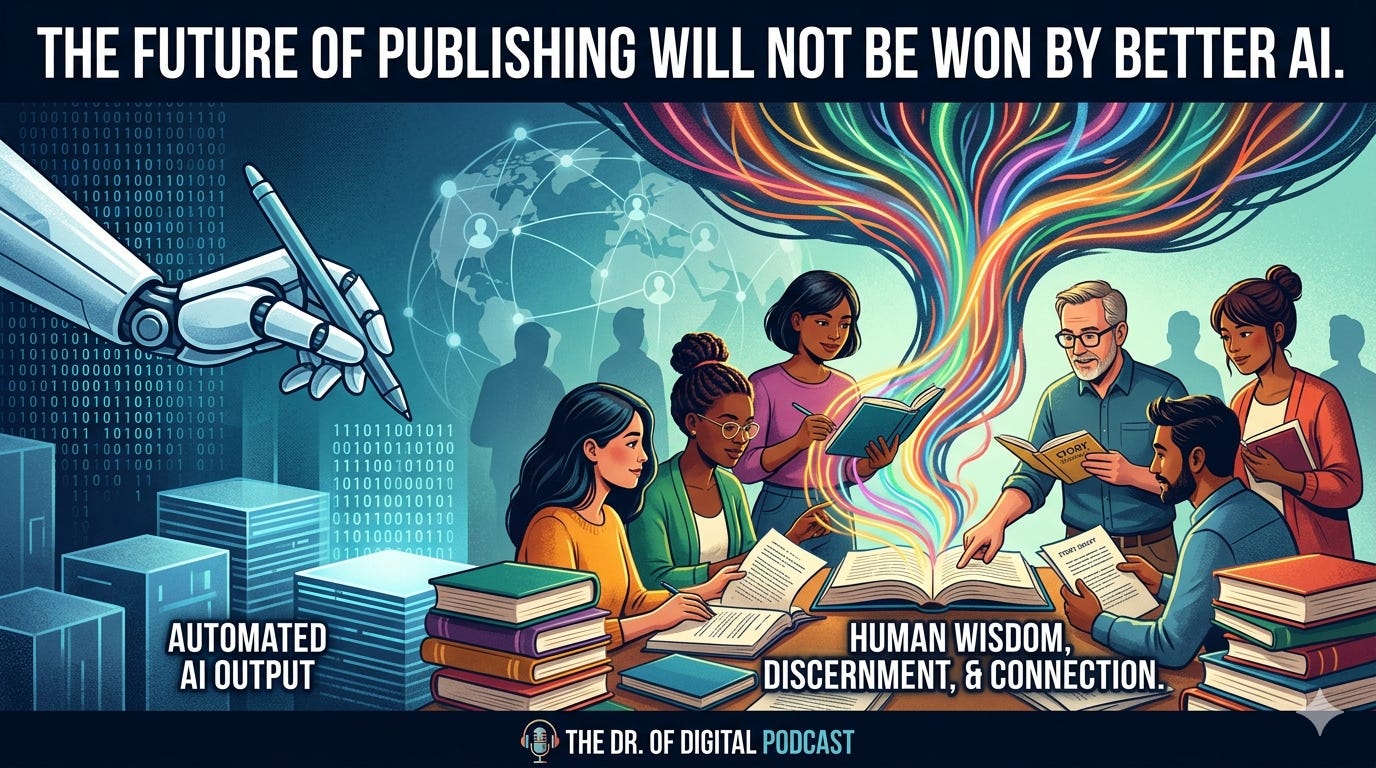
The future will not belong to those who can produce the most.
It will belong to those who can still discern what is worth saying.
That is not a technological challenge.
It is a human one.
And it may be the defining calling of our time.
I help high-level experts turn their expertise into commercially powerful nonfiction books and authority platforms.
American Patriot
G. Mick (The Doctor of Digital) Smith, PhD
==========================================
https://www.linkedin.com/in/g-mick-smith-phd-24495127/
Subscribe to my LI Newsletter https://www.linkedin.com/newsletters/the-literary-cpr-playbook-7343709688632381440
Book Coach for CEOs, leaders, and visionaries | Authors Get Published | Books that Convert Clients [ Trusted Advisor | Manuscript Doctor 🚨 | Transforming Drafts into Authority Assets | Strategic Publishing Guidance
AI-generated graphic